SSI Traffic Solutions: Traffic Safety Products in USA and Canada
Traffic Safety Products in USA and Canada

Choosing a kitchen faucet accessory supplier is not just a price comparison. For importers, brands, and product teams, the right partner can affect fit, finish, delivery consistency, and customer support. This guide to 2026 Best Kitchen Faucet Accessories OEM Suppliers explores what buyers should examine before requesting samples or negotiating production. Details matter.
A reliable Kitchen Faucet Accessories Oem partner should explain material options, surface finishes, production capacity, quality checks, and customization limits in clear terms. Ask how the supplier handles sample approval, packaging, and changes between production runs. A polished catalog helps, but it does not prove that every batch will match. Request specifications and sample pieces, then check thread fit, coating, and moving parts under ordinary use.
The comparison also considers communication, lead times, minimum order quantities, and after-sales processes. These factors can vary by product type and order size, so a single ranking may not suit every buyer. That is worth remembering. Supplier claims should be verified through direct questions, documented specifications, and, where practical, independent inspection. Even careful checks cannot remove every uncertainty. This overview aims to make those uncertainties easier to discuss, while helping readers identify suppliers whose capabilities match their product plans, budgets, and quality expectations.
2026 Best Kitchen Faucet Accessories OEM Suppliers
Kitchen Faucet Accessories: Product Categories and OEM Supply Models
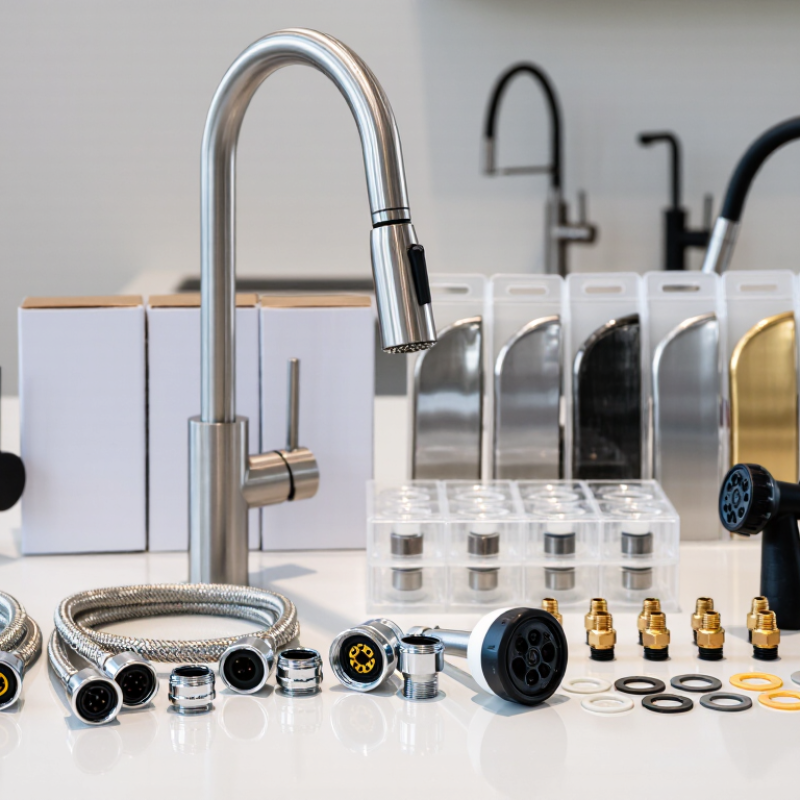
Kitchen faucet accessories range from pull-down spray heads and flexible hoses to aerators, cartridges, mounting plates, and soap dispensers. OEM buyers can source finished assemblies or specify individual components. Common models include custom OEM production, modular ODM designs, and private-label supply. Each requires clear drawings, material specifications, and sample approval. Small mismatches matter: a hose that kinks under the sink can spoil an otherwise sound faucet.
The U.S. EPA’s WaterSense program reports cumulative savings exceeding 7.5 trillion gallons since 2006. This figure covers multiple product categories, not kitchen faucets alone, so it should not be treated as a kitchen-accessory sales statistic. Still, it highlights why buyers increasingly review flow performance alongside durability. Ask suppliers for documented flow tests, leak checks, and cartridge cycle results. A polished sample can hide a weak hose crimp; one inspection may not catch everything.
Tips: Request a complete accessory kit for fit checks, then test it under typical household pressure. Confirm minimum order quantities, tooling ownership, replacement-part availability, and packaging details before approving production. Keep one approved sample as a reference. Don’t skip the awkward details.
For OEM kitchen faucet accessories, the finish is only as dependable as the metal beneath it. Start with 304 stainless steel when corrosion resistance and a clean, neutral appearance matter. Ask suppliers for material certificates and grade verification, not just “stainless” on a quotation. Brass is useful for compact connectors and shaped components because it machines well. Its exact alloy matters: composition can affect color, strength, and compatibility with the chosen coating. Small details count. A thin or uneven finish can show wear around threaded joints first.
The International Stainless Steel Forum reported 58.4 million tonnes of global stainless-steel melt-shop production in 2023. This figure covers all stainless grades, not 304 alone, so it indicates industry scale rather than 304 availability. For surface treatments, compare brushed, polished, electroplated, and physical vapor deposition finishes using the same lighting and cleaning method. Brushed textures can disguise fingerprints, while polished surfaces show them quickly. Request coating-thickness records and test reports for abrasion, adhesion, and corrosion resistance. One limitation: laboratory tests cannot represent every household cleaner or cleaning habit. Ask for a small production sample; inspect the edges, spray-head seams, and underside, where finish quality is easy to overlook.
| Accessory or Component | Common Base Material | Material Facts | Typical Surface Treatments | Selection Considerations | OEM Specification Checks |
|---|---|---|---|---|---|
| Pull-down spray head | 304 stainless steel shell, brass components, or engineering-grade polymer | 304 stainless steel is commonly described as 18/8 stainless steel, referring nominally to chromium and nickel content. Actual composition should be confirmed by material documentation. | Brushed or satin finish; polished finish; decorative PVD coating on compatible substrates | Consider hand feel, weight, scratch visibility, spray-button durability, and compatibility with the faucet finish. Stainless steel resists corrosion but is not immune to staining or corrosion in all environments. | Confirm material by component, finish sample approval, spray pattern, button-cycle testing, and compatibility with the hose connection. |
| Faucet body and base | Lead-free brass or 304 stainless steel | Brass is a copper-zinc alloy; its exact composition varies by grade. “Lead-free” claims should be supported by applicable product and material documentation. | Polished chrome plating; brushed or satin finish; PVD; clear protective coating where specified | Brass is readily machined and widely used for faucet bodies. Stainless steel offers a different appearance and material profile. Compare weight, machining requirements, and corrosion performance for the intended water and installation conditions. | Request the alloy grade, component-level material declaration, dimensional drawings, and applicable potable-water compliance documentation for the destination market. |
| Escutcheon plate and mounting hardware | 304 stainless steel, brass, or plated metal | Thin sheet components may use a different material or thickness from the faucet body; do not assume all visible parts share the same substrate. | Brushed, satin, or polished finish; chrome plating; PVD | Check edge quality, flatness, finish consistency, and resistance to water spotting. Match the visible finish to the faucet body under consistent lighting. | Specify substrate, thickness, dimensions, finish reference, and acceptable color variation for each visible part. |
| Soap dispenser pump and spout | Stainless steel or brass spout; polymer or metal pump components | The external spout material may differ from the pump mechanism and bottle. Material claims should identify the specific component. | Brushed or polished metal finish; chrome plating; PVD on suitable parts | Evaluate pump priming, refill access, soap compatibility, and resistance to residue buildup. Confirm that the finish can tolerate the cleaning products expected in use. | Test dispensing performance with representative soap, refill access, leakage, and finish appearance after cleaning cycles. |
| Air gap cover or accessory cap | 304 stainless steel, brass, or polymer with a decorative coating | Small covers can use a different substrate from the main faucet. Material selection should account for the local installation requirements. | Brushed or polished finish; chrome plating; color-matched PVD or coating where available | Check fit, ventilation or drainage requirements where applicable, and color match with adjacent fittings. | Confirm local plumbing requirements, opening dimensions, attachment method, and finish match using production samples. |
| Decorative chrome finish | Usually applied over a prepared metal substrate, such as brass or stainless steel | Chrome is a surface finish rather than a base material. Plating systems may include multiple underlayers depending on the substrate and specification. | Polished chrome; satin or brushed chrome | Appearance and durability depend on substrate preparation, plating process, and care. Avoid assuming identical performance across different suppliers or substrates. | Specify appearance standards, substrate, plating process requirements, adhesion checks, and corrosion-test method and acceptance criteria. |
| Physical vapor deposition (PVD) finish | Compatible prepared metal substrates, including some stainless steel and brass components | PVD is a family of vacuum-deposition processes. Finish color and performance depend on coating composition, substrate preparation, and process control. | Common options include dark, gold-tone, bronze-tone, and other metallic appearances | Request samples because color can vary between processes and production lots. Follow the supplier’s cleaning instructions to protect the coating. | Approve a physical master sample; define color tolerance, coating coverage, adhesion and wear tests, and production-lot inspection criteria. |
| Brushed or satin finish | 304 stainless steel or brass, sometimes with an additional protective or decorative layer | “Brushed” describes surface appearance and texture, not a specific alloy or coating. Grain direction and roughness affect the final look. | Mechanical brushing; satin finishing; optional clear coating or PVD | Compare grain direction, sheen, and water-spot visibility across all visible components. Cleaning methods should suit the actual substrate and coating. | Define finish reference, grain direction, gloss range or visual criteria, and sample approval requirements. |
For 2026 kitchen faucet accessory sourcing, lead content deserves close attention. NSF/ANSI 372 sets a maximum weighted-average lead content of 0.25% across wetted components. The U.S. EPA’s Lead-Free Requirements for Plumbing Products guidance also identifies a 0.25% limit for wetted surfaces, with a separate 0.2% limit for solder and flux. These figures matter for spray heads, hose connectors, and valves—not just the faucet body.
The calculation considers each wetted component’s surface area, so a small brass fitting can affect the assembly’s result. NSF/ANSI 372 assesses lead content; it is not a test of lead leaching. Small parts matter.
OEM buyers should request current test reports, material declarations, and certificates that identify the tested model and components. Check that the documents match the production version, not merely a visually similar sample.
A reliable supplier should explain how material changes, machining, and supplier substitutions are controlled. Ask for traceability from alloy batch to finished accessory, plus a clear process for retesting changed parts. EPA guidance and the NSF standard provide useful reference points, but paperwork alone cannot verify every shipment.
One detail is easy to miss: accessory kits may combine parts from multiple factories. Review the full wetted path, and document any gaps before approving production.
For U.S. kitchen faucets, the key flow benchmark is 2.2 gallons per minute at 60 psi. The U.S. Department of Energy lists this maximum in its appliance standards, under 10 CFR 430.32(o). It is a ceiling, not a guarantee of identical flow at every sink. Household pressure, supply hoses, and aerators can all change the stream. Small parts matter.
For OEM buyers, accessory testing should match the faucet’s intended pressure and use. A spray head may feel weak when a narrow hose or restrictive diverter cuts delivery. An aerator can shape the stream, but its rating alone does not describe rinsing performance. Check measured flow, spray coverage, leakage, and switching durability. DOE’s flow limit provides a useful U.S. compliance reference; ASME A112.18.1/CSA B125.1 also sets plumbing-fixture performance and test requirements. Ask suppliers for test conditions and results, not just catalog specifications. A plain bucket-and-timer check can reveal inconsistencies, though it is not a substitute for standardized testing.
Maximum rated flow in gallons per minute (gpm) at 60 psi
The U.S. federal maximum for kitchen faucets is 2.2 gpm at 60 psi. California’s state standard is lower, at 1.8 gpm. These are regulatory maximum flow rates, not measurements of every faucet’s actual performance.
Sources: U.S. Code of Federal Regulations, 10 CFR § 430.32; California Energy Commission, Appliance Efficiency Regulations.
Evaluating a 2026 OEM supplier takes more than comparing unit prices. Grand View Research estimated the global kitchen faucet market at about US$7.1 billion in 2023 and projected 6.8% annual growth through 2030. That growth makes supplier capacity worth checking, but a market forecast cannot confirm factory performance. Ask who owns the tooling, how mold repairs are charged, and whether replacement inserts remain available. Request a pilot run before committing to a large order. Small details matter.
MOQ discussions should separate faucet bodies, cartridges, hoses, and finishes; their production constraints differ. Ask for written sampling and lead-time schedules, plus test records tied to the exact model and materials. Useful checks include leak and pressure testing, cartridge-cycle testing, and finish corrosion testing. I still find packaging easy to overlook: a scratched handle can turn a sound production run into costly rework. Ask how defects are recorded and corrected.
For North American potable-water applications, suppliers may need evidence of compliance with NSF/ANSI/CAN 61 and NSF/ANSI 372, depending on product scope and market requirements. Confirm the certificate covers the actual model, wetted materials, and factory—not merely a similar sample. Request independent laboratory reports and verify their dates. A certificate is not a substitute for routine production checks. Be cautious when an MOQ looks unusually low; it may exclude testing, finish setup, or tooling costs.