SSI Traffic Solutions: Traffic Safety Products in USA and Canada
Traffic Safety Products in USA and Canada

Choosing a Solar Power System For Rv can feel simple until the campsite becomes quiet and cloudy. A dependable setup must match your travel habits, roof space, battery needs, and available sunlight. This guide examines China-made RV solar systems with practical buying decisions in mind. It focuses on performance, component quality, safety, and long-term value.
Real-world use matters. A 400-watt array may run lights, phones, a router, and a small refrigerator. It may not support an air conditioner for an entire night. Battery capacity, inverter efficiency, wiring, and weather conditions can change the result. Small details matter. A loose connector can waste energy. Poor ventilation can shorten battery life. Clear installation instructions also make a difference during roadside repairs.
Manufacturers in China offer many system sizes and configurations. Some provide flexible panels, lithium batteries, MPPT controllers, and monitoring apps. Buyers should check test reports, warranty terms, production experience, and after-sales support. Look for recognized safety standards where applicable, and confirm whether the supplier can provide traceable specifications. Marketing claims are not always complete. I have found that estimated daily output often looks better than real campsite performance. That gap deserves attention.
This introduction sets a practical direction for comparing complete kits and individual components. It considers different RV layouts, seasonal travel, power budgets, and installation limits. The best choice is not always the largest system. It is the system that works predictably, remains serviceable, and fits your actual journey. Expect trade-offs. That is normal.
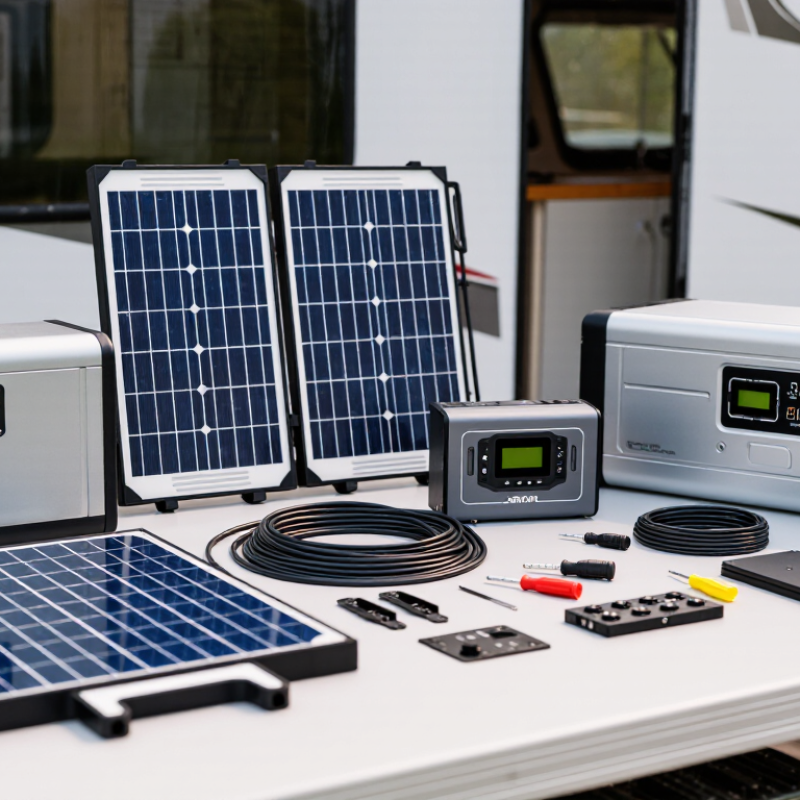
Sizing an RV solar array starts with measured energy use, not roof space. List each appliance, its wattage, and daily operating hours. A 12-volt compressor refrigerator may consume 400–800 watt-hours daily, depending on weather and ventilation. Add lights, water pumps, fans, device charging, and an inverter’s standby draw. A small setup may need 200 watts. Regular off-grid camping often suits 400–600 watts.
The final factor allows for wiring, controller, temperature, and cloudy-weather losses. For example, 1,200 watt-hours divided by four sun hours and 0.75 requires about 400 watts. Panel ratings are laboratory figures. Real output can disappoint under roof shade, dust, low winter sun, or poor panel angles. My early estimates were too optimistic because I ignored evening inverter use.
Tips: Track battery usage for three camping days before buying. Check the roof after noon for shadows from vents and air conditioners. Leave space for safe wiring and future expansion. Confirm that the charge controller matches the array voltage and current. A 600-watt array will not solve every problem. Heavy heating appliances can exceed its daily production quickly. Reduce unnecessary loads, and size the battery to cover overnight demand.
For RV owners, monocrystalline panels are often the strongest choice when roof space is limited. Their typical module efficiency reaches about 20–23%, according to the Fraunhofer Institute for Solar Energy Systems’ Photovoltaics Report 2024. Higher efficiency means more electricity from a smaller roof area. This matters when air conditioners, refrigerators, and communication devices compete for limited solar space.
Performance also depends on temperature, shading, and installation angle. The IEA PVPS Trends 2024 report confirms that crystalline-silicon technology remains the dominant photovoltaic platform worldwide.
In practical RV use, a 400-watt panel may produce less than its rated output under hot midday conditions or partial shade from a roof vent. Leave room around vents. Airflow helps reduce heat buildup, although it will not remove every loss.
A careful buyer should check the panel’s temperature coefficient, dimensions, weight, and low-light behavior.
Efficiency alone can mislead. A larger 23% panel may not fit between roof fixtures, while a compact 20% panel could provide a cleaner installation.
I have found that cable routing often creates more trouble than panel selection. Measure twice. Real travel conditions are messier than laboratory ratings, and even reputable data cannot predict every campsite.
China Best Solar Power System for RVs Buying Guide
A 100 Ah LiFePO4 battery usually has a nominal voltage of 12.8 volts. Its stored energy is therefore 1.28 kWh. This figure is useful, but it is not the whole story. In an RV, the inverter, wiring, battery reserve, and temperature can reduce available energy. A realistic usable amount may be closer to 1.0–1.15 kWh, depending on the system design and operating conditions. Check the battery specification carefully.
Think in daily loads, not only amp-hours. A 45-watt refrigerator running for 12 hours uses about 0.54 kWh. Add LED lights, a water pump, phone charging, and small electronics. A 100 Ah battery may support one comfortable day, but heavy heating or cooking can drain it quickly. My first estimate was too optimistic when I ignored inverter losses. Real RV use is less tidy than a worksheet.
Tips: List every appliance and its wattage. Multiply watts by daily running hours, then add a safety margin of 20–30 percent. Keep high-power appliances limited. Select a compatible charge controller, proper fuses, and correctly sized cables. Solar production changes with shade, season, roof angle, and clouds. A second battery may be more practical than forcing one battery to cover every demand.
An RV solar system must match its controller, inverter, panels, and battery. MPPT controllers continuously adjust operating voltage. This helps panels work near their maximum power point, especially during cold mornings, partial shade, or long cable runs. Under favorable mismatch conditions, MPPT can harvest up to 30% more energy than basic PWM control. The gain is not guaranteed.
Cold mornings matter. Panel voltage rises as temperatures fall, so check the controller’s maximum input voltage carefully. A 200-watt panel array may produce more than its rated power in bright, cool weather. The controller should also support the battery’s charging voltage and chemistry. Undersizing can create clipping. Oversizing may waste money.
The 2024 IEA PVPS Trends report recorded about 447 GW of new solar capacity worldwide in 2023, showing how quickly photovoltaic technology is scaling. For RV use, however, compact systems face harsher constraints. NREL’s PVWatts documentation uses 96% as a default inverter efficiency, before cable, controller, and battery losses. Choose an inverter with sufficient continuous output and short-duration surge capacity. A refrigerator startup can expose weak sizing.
Real losses remain. I once treated the “30% more” figure too broadly. It describes a possible operating advantage, not a permanent performance promise. Compare the panel voltage range, expected temperature, shading pattern, and daily energy demand before buying. A practical test uses a clamp meter and charge data across several travel days.
When choosing a solar power system for an RV, Chinese quality needs evidence, not slogans. IEC 61215 verifies design performance under stress, including heat, humidity, and mechanical loading. IEC 61730 focuses on electrical and fire safety. Neither certificate alone guarantees long-term field performance. Check the exact module model, certificate number, testing laboratory, and manufacturing site.
The IEA PVPS Trends 2024 report recorded more than 1.6 terawatts of global photovoltaic capacity by the end of 2023. That scale increases confidence in mature technology, but quality still varies between factories.
NREL’s photovoltaic degradation review found a median degradation rate near 0.5% annually. For an RV roof, ask whether the warranty covers this decline. Separate product and performance warranties.
Read exclusions for salt air, vibration, shading, improper installation, and cracked connectors. A ten-year promise may sound strong, yet claim procedures can be unclear.
Tips: Request the full IEC reports, not only a certificate image. Confirm warranty duration, power-retention thresholds, labor coverage, and replacement shipping.
Photograph serial labels during installation. I once overlooked connector compatibility, and the panel performed well while the system still lost energy. That mistake remains instructive.
Choose documented testing over attractive efficiency figures, especially when the RV travels through hot deserts and freezing mountain roads.