SSI Traffic Solutions: Traffic Safety Products in USA and Canada
Traffic Safety Products in USA and Canada

Choosing the right traffic control equipment manufacturer affects road safety, project continuity, and long-term maintenance costs. This guide examines China’s top 10 manufacturers through practical, measurable criteria. These include product quality, certification, manufacturing capacity, export experience, customization, and after-sales support.
The review considers signal controllers, LED traffic lights, pedestrian systems, road barriers, variable message signs, traffic cones, and solar-powered warning devices. Factory scale alone proves little. A bright signal visible through rain matters more. So does a stable controller during a crowded intersection’s peak hour. Field performance tells the fuller story.
Transportation engineer Gene Hawkins has emphasized, “Traffic control devices must be designed and operated to meet the needs of road users.” That principle guides this comparison. It encourages buyers to examine visibility, timing accuracy, enclosure protection, installation guidance, and replacement-part availability. Some manufacturers present impressive catalogs, yet provide limited testing evidence. That weakness deserves attention.
The ranking is not an absolute verdict. Regional standards, climate, budgets, and project scope can change the best choice. A coastal highway needs corrosion resistance. A city junction needs dependable communication and simple maintenance. Procurement teams should verify certifications, factory records, sample performance, and warranty terms before signing contracts. This introduction may overlook smaller specialist suppliers. That is worth questioning. Still, it provides a grounded starting point for identifying capable Chinese manufacturers and matching their strengths with real traffic-management needs.
What Is Traffic Control Equipment and Why Does It Matter?
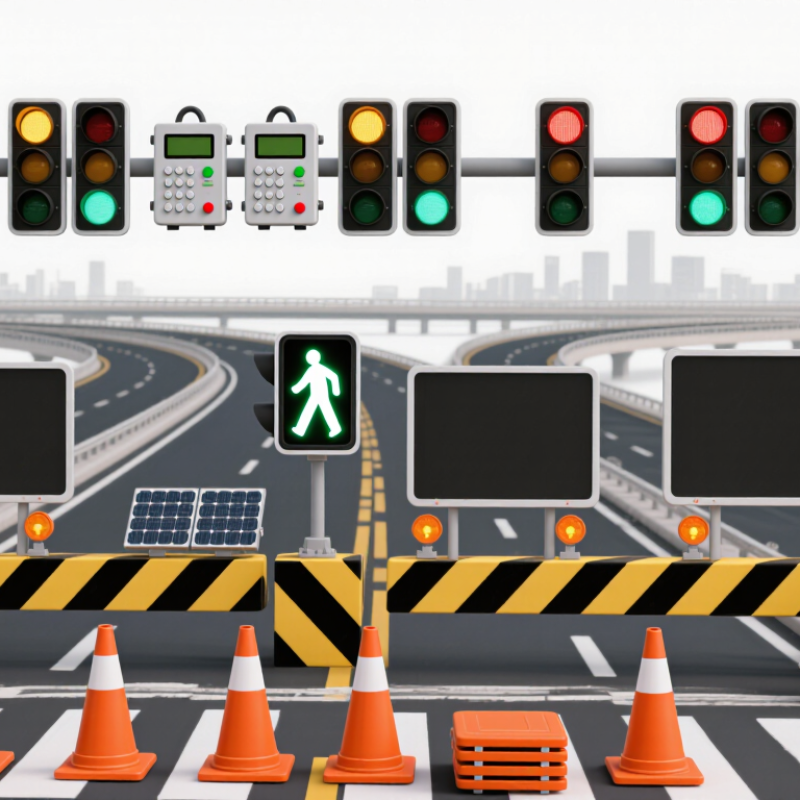
Traffic control equipment manages how vehicles, cyclists, and pedestrians move through shared spaces. It includes cones, barriers, warning signs, signal systems, road studs, speed displays, and portable message boards. Each item has a practical role. Cones guide drivers around hazards, while barriers separate people from moving traffic. Visibility matters. Reflective surfaces, strong colors, and bright lighting help users recognize changes quickly, especially at night or during heavy rain.
A practical site inspection should consider traffic speed, road width, weather, and pedestrian behavior. Equipment must remain stable under wind, impact, and repeated handling. It should also be easy to install, inspect, clean, and replace. Poor placement can create confusion instead of preventing it. People make mistakes. Clear spacing and consistent signs reduce hesitation near crossings, construction areas, and temporary lane changes. Reliable equipment also supports emergency access and helps workers stay outside moving lanes.
Manufacturers are often evaluated by material quality, testing records, production control, and after-sales support. However, product claims should not replace field verification. A warning board may meet a specification but still perform poorly under glare. No setup is perfect. A plan can look excellent on paper, yet fail during rain or heavy traffic. Regular inspections should check faded markings, loose bases, damaged lamps, and blocked signs. Small defects can become serious when drivers have only seconds to react.
| Rank | Equipment Manufacturing Category | Typical Products | Common Technical Parameters | Relevant Standards or References | Typical Applications | Why It Matters |
|---|---|---|---|---|---|---|
| 1 | LED Traffic Signal Equipment | Vehicle signal heads, arrow signals, countdown timers, and flashing warning lights | Red, yellow, and green signal modules; typical diameters of 200 mm or 300 mm; LED service life commonly rated above 50,000 hours | GB 14887-2011; project-specific traffic signal specifications | Urban intersections, pedestrian crossings, school zones, and temporary roadworks | Provides clear right-of-way instructions and improves visibility compared with conventional incandescent signal technology |
| 2 | Traffic Signal Controllers | Single-intersection controllers, coordinated controllers, cabinet systems, and remote-control units | Multi-phase timing, vehicle and pedestrian phase management, detector inputs, emergency priority, and network communication | GB/T 31418-2015; GB 14887-2011; local traffic management requirements | Signalized junctions, arterial corridors, smart-city platforms, and adaptive traffic systems | Coordinates signal timing, reduces conflicting movements, and supports traffic flow optimization |
| 3 | Variable Message Signs | LED information boards, lane-control signs, graphical signs, and portable message boards | Amber, red, green, or full-color displays; optical visibility commonly designed for daytime and nighttime operation; remote content control | GB 5768.2-2022; GB/T 23828-2023 where applicable; highway authority specifications | Expressways, tunnels, toll approaches, congestion zones, and emergency diversion routes | Communicates changing road conditions quickly and helps drivers select safer routes |
| 4 | Vehicle Detection Sensors | Inductive-loop detectors, radar detectors, video detection systems, and microwave sensors | Vehicle presence, speed, occupancy, queue length, classification, and traffic-volume measurement | Applicable intelligent transport system specifications and approved traffic detection test procedures | Intersections, expressways, parking facilities, tunnels, and traffic management centers | Supplies real-time data for signal control, congestion analysis, and incident response |
| 5 | Traffic Monitoring Cameras | Road surveillance cameras, traffic flow cameras, incident-detection cameras, and integrated monitoring units | High-definition imaging, infrared or low-light operation, pan-tilt-zoom options, weather protection, and network transmission | GA/T 995-2022; GB/T 28181-2016 for applicable video-surveillance networking | Road corridors, bridges, tunnels, intersections, and traffic operation centers | Improves visibility of incidents, traffic conditions, and unsafe behavior for faster response |
| 6 | Road Traffic Signs and Sign Supports | Regulatory signs, warning signs, direction signs, overhead signs, gantries, and signposts | Retroreflective sheeting, aluminum or galvanized-steel substrates, standardized symbols, and wind-load design | GB 5768.2-2022; GB/T 18833-2012 for retroreflective materials where applicable | City roads, national highways, expressways, work zones, and parking areas | Delivers consistent guidance and warnings, especially where drivers have limited decision time |
| 7 | Road Marking and Delineation Equipment | Thermoplastic marking machines, paint striping machines, road studs, delineator posts, and reflective markers | Line width control, glass-bead reflectivity, hot-melt application, solar or passive reflectors, and weather resistance | GB 5768.3-2009; GB/T 24722-2020 for applicable glass beads | Lane boundaries, pedestrian crossings, curves, medians, ramps, and highway shoulders | Defines lanes and road edges, supporting safe navigation during daylight and nighttime driving |
| 8 | Speed Display and Enforcement Support Equipment | Radar speed displays, speed-warning signs, portable speed indicators, and data-recording units | Radar-based speed measurement, LED speed display, configurable speed thresholds, and optional solar power | Project-specific metrology, road-sign, and traffic enforcement requirements | Residential roads, school zones, work zones, tunnels, and high-risk highway sections | Provides immediate driver feedback and can encourage compliance with posted speed limits |
| 9 | Road Safety Barriers and Channelization Equipment | Water-filled barriers, crash cushions, traffic cones, temporary fencing, bollards, and lane separators | Impact absorption, visibility, retroreflective surfaces, modular installation, and resistance to weather and UV exposure | GB 5768.4-2017; JT/T 596-2004 for applicable highway safety barriers | Construction zones, lane closures, toll areas, event traffic management, and emergency scenes | Separates vehicles from hazards and workers while creating temporary traffic routes |
| 10 | Parking and Access Control Equipment | Parking guidance displays, vehicle barriers, ticketing terminals, access gates, and parking sensors | Vehicle detection, barrier opening and closing control, license-plate integration, occupancy monitoring, and network connectivity | GB/T 50314-2015; local parking facility design and intelligent transport requirements | Public parking facilities, airports, hospitals, commercial districts, campuses, and residential communities | Regulates vehicle access, improves parking circulation, and reduces unnecessary searching traffic |
Choosing China’s top 10 traffic control equipment manufacturers requires more than checking sales volume. A credible selection process combines factory experience, product reliability, engineering capability, and verified customer feedback. Equipment should perform under rain, dust, heat, and heavy daily traffic.
The evaluation begins with production evidence. Inspectors can review testing laboratories, quality records, material control, and assembly procedures.
They should also examine traffic lights, variable message signs, barriers, controllers, and detection devices in real projects.
Relevant certifications matter, but certificates alone cannot prove long-term performance. Field data, maintenance response, delivery consistency, and product customization deserve equal attention.
The ranking should also consider technical support and compliance with local road standards. A manufacturer with clear manuals and responsive engineers reduces installation mistakes. However, no selection method is perfect. Public project data may be incomplete, and some performance claims remain difficult to verify. That weakness should be disclosed rather than hidden.
Tips: Request test reports, installation photos, warranty terms, and recent project references. Compare failure rates, spare-part access, software updates, and response times. Visit the facility when possible. Ask practical questions, such as how equipment performs after repeated power interruptions. A polished presentation can still hide weak after-sales support.
China’s leading traffic control equipment manufacturers are best assessed through verified projects, certification records, product depth, and after-sales capability. Public procurement data and China Intelligent Transport Systems Association reports commonly highlight ten recurring manufacturer groups. They supply traffic signals, adaptive controllers, electronic signs, speed displays, lane-control systems, vehicle detectors, and portable warning units. The strongest suppliers usually combine hardware production with traffic software and field maintenance. That matters in real streets.
Scale is substantial. China’s Ministry of Transport reported about 5.44 million kilometers of roads in 2023, including more than 177,000 kilometers of expressways. This network creates steady demand for reliable control equipment.
The top ten manufacturers typically serve municipal intersections, tunnels, expressways, airports, and industrial parks. Their performance should be checked against controller response time, enclosure protection, power backup, cybersecurity testing, and repair records. Factory capacity alone proves little.
A careful buyer should compare independent test reports, installation evidence, and tender delivery history. China’s National Bureau of Statistics also shows continuing urban infrastructure investment, supporting long-term market demand. However, market rankings remain imperfect because public tender data may favor large projects. Smaller specialists can outperform larger suppliers in niche deployments. That is worth remembering. Field conditions are messy, and published case studies rarely show every failure, delay, or maintenance cost.
China’s leading traffic control equipment manufacturers supply more than standard signal lights. Their product lines often include LED traffic signals, pedestrian crossings, signal controllers, lane-control signs, and variable message boards. Many also produce radar speed displays and portable warning devices.
Modern systems combine video detection, radar sensing, and edge computing. These tools measure queue length, vehicle flow, and pedestrian movement in real time. Adaptive controllers can adjust signal timing when traffic patterns change.
Some manufacturers provide cloud platforms for remote monitoring, fault alerts, and maintenance records. Vehicle-to-infrastructure communication is also developing, although local compatibility remains important.
Field details matter. Cabinets may need waterproof seals, surge protection, cooling systems, and battery backup. Engineers usually test signal visibility under rain, fog, strong sunlight, and heavy dust. Factory quality checks can include burn-in tests, wiring inspections, and controller communication trials. A polished demonstration can hide installation weaknesses. Not every smart cabinet performs well in a crowded intersection. Sensor calibration may drift, and software updates can interrupt older equipment. Buyers should request test reports, integration documents, spare-parts plans, and service response times. On-site experience still matters more than attractive specifications. Reliability grows through repeated testing, clear documentation, and practical maintenance.
Choosing a Chinese traffic control equipment manufacturer requires more than reading a top-ten list. The World Health Organization’s Global Status Report on Road Safety 2023 estimates 1.19 million road deaths annually. Therefore, signal reliability, visibility, and maintenance support deserve measurable attention. China’s Ministry of Transport reported more than 5.4 million kilometers of public roads by the end of 2023. That scale creates demanding conditions, from coastal humidity to dusty inland intersections.
Compare manufacturers through documented evidence. Request test reports for signal heads, controllers, cabinets, variable message signs, and communication modules. Check operating temperature, ingress protection, electrical safety, LED lifetime, and failure rates. Certifications should match the destination market, not merely a supplier’s preferred paperwork. ISO 9001 supports process control, but it does not prove field performance. Ask for traceable component records and samples from current production.
A practical evaluation should include factory audits, reference installations, spare-parts planning, and remote diagnostic capability. The supplier should explain firmware updates and cybersecurity controls in plain language. Pilot testing matters. A spreadsheet can mislead. Measure signal brightness after heat exposure, cabinet temperature, response time, and repair speed. Compare the five-year ownership cost, not only the quoted unit price. Some manufacturers communicate quickly before payment, then respond slowly after delivery. That possibility deserves a written service-level agreement, acceptance criteria, warranty terms, and penalties for missed support commitments. Review the evidence twice.